
This article is a companion piece to One Dish, our social series showcasing NYC chefs and their their best-known dishes. This season is hosted by Justin Wu (@hungryartistny) who creates illustrations of his favorite NYC eats. Watch the video on our Instagram page.
Inside Printemps New York, the first US outpost of the storied French luxury department store, chef Gregory Gourdet brings his culinary vision to life at flagship restaurant Maison Passerelle. The Queens-born chef of Haitian descent, known to many from Top Chef, oversees all the cafés and restaurants inside Printemps, but Maison Passerelle carries a personal focus. His menu melds French culinary techniques interpreted through the cuisines of the French-speaking diaspora, from the nations of the Caribbean to West Africa.
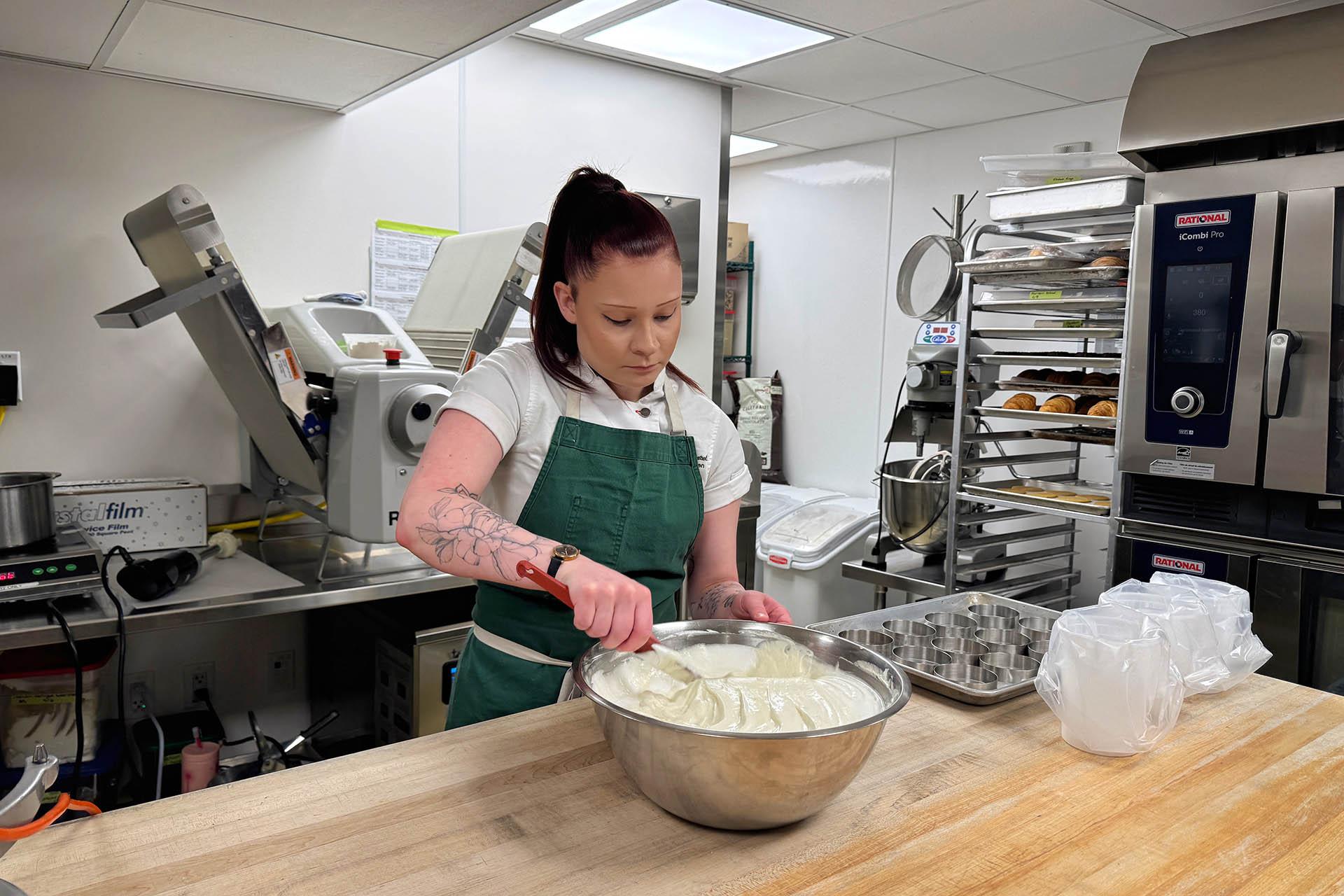
That approach extends to the dessert menu through executive pastry chef Rachel Green, who spent much of her career working in savory kitchens before pivoting into pastry. Her coconut chiboust—a pastry cream and meringue combo that’s “essentially a free-form souffle,” according to Green—has quickly become one of the restaurant’s most sought-after dishes, undergoing multiple iterations under Gourdet’s mentorship as Green refined its balance of sweetness, texture and flavor.
We spoke with Green about creating the dessert, her transition from savory to pastry and what makes the final dish work.

Why did you choose the coconut chiboust for One Dish?
Rachel Green: The coconut chiboust is a particularly meaningful dish to me, taught by my mentor, who showed me how to adapt not only its flavors but the character of the entire dish as the seasons change.
We read that this dessert played a role in you landing the job at Maison Passerelle. Can you tell us that story?
RG: I presented four desserts for my tasting, each highlighting different styles and techniques. The chiboust, served near the end, was quickly identified as a potential signature dessert for the restaurant.

Can you walk us through how the flavors and textures come together?
RG: On the plate, the dish balances temperature with warm chiboust, chilled pandan anglaise and frozen coconut sorbet. A range of textures ties it together, from a crisp sablé base to the light, airy chiboust and the smooth, creamy finish of the anglaise and sorbet.

What’s the key element that makes this dish stand out?
RG: The use of dehydrated makrut lime leaf powder adds a subtle but distinctive element. It brings depth and roundness to the existing flavors—lemongrass, pandan, coconut—while also introducing a vibrant green color to an otherwise neutral-toned dish.
You started as a savory chef—how has that background shaped the way you approach pastry?
RG: Early in my career, learning savory techniques and flavors gave me a foundation I still rely on today. It shaped how I think about balance, the use of spice, smoke and fire and really reinforced how important it is to season every component with intention.
Can you tell us a bit about how you got into cooking, and what inspires you? For example, we read that your mother is an herbalist—do those influences show up here?
RG: I can’t remember a time when I didn’t want to be a chef—even in early childhood, it always felt like the only path for me. I feel very fortunate to have people around me who believe in me, give me opportunities to prove myself, and continue to push me to learn and grow in the position I’m in.
My mother is an herbalist with her own business, and growing up around a wide range of herbs and spices had a big influence on me. That early exposure continues to shape how I think about flavor, and you can see that influence reflected throughout all the menus at Printemps, especially Maison Passerelle, which is my ultimate playground.
What drew you from savory into pastry?
RG: The precision, science and meticulous nature of pastry has always drawn me in. What I find most interesting is working with ingredients that aren’t inherently enjoyable on their own—like flours, sugars and leavening agents—and transforming them into something not only edible but genuinely enjoyable.
How has the dish evolved from your first iteration to what’s on the menu now?
RG: This dish has continued to evolve through more intricate infusions, added techniques and elements, and a deeper exploration of balance between sweetness and acidity. I can’t say too much but the next version, which I’m very excited about, is in testing and will be launching soon!

Is this your most popular dessert? What do you think guests respond to about it?
RG: The chiboust has been one of the most well-received desserts on the menu. People mention its light, fluffy texture and how it isn’t overly sweet, which is commonly expected from a souffle-like dessert.

Is there anything you recommend pairing with it—wine or otherwise?
RG: I don't have the perfect pairing for wine off the top of my head, but I personally will never turn down a good glass of champagne or sparkling wine with dessert!

