There are lots of ways to understanding the importance and impact of soccer in the five boroughs. You can discover it through homegrown soccer pros, NYC soccer’s influence on style and the many fun bars and restaurants where fans go to watch their favorite teams play. But getting into the game with locals who make time to play soccer after work or school and build ever-growing communities offers a ground-level view into how the sport thrives here.
The City’s soccer clubs also act as a microcosm of the many communities and neighborhoods they represent. Read on and see how a few of New York City’s football clubs (and a futsal club!) make the game work in a place the rest of the world imagines as a concrete jungle and how each represents a slice of city life in their own personal way.
Bowery FC
Photographs by Amir Hamja

Bowery FC players at Martin F. Tanahey Playground in Manhattan's Lower East Side
Pickup soccer is the heartbeat of the local game. It’s where young players cut their teeth, college players prep for preseason, corporate 20-somethings try to stay in shape after work and, every once in a while, where you’ll find a pro player sneaking in some extra training. All these different walks of life come together for the love of the game.
Bowery FC captures this sentiment and transforms it into something entirely their own. What started as pickup games between friends back in 2001 evolved into a New York City institution, functional enough to give local ballers spaces to strut their stuff for a quarter century and polished enough to partner with top brands in the space like Grailed, Only NY and Lotto Sport.
“The level is what I’d call ‘friendly competitive,’” says founder Carlos Franco of Bowery FC. “Everyone plays hard, with the understanding that we all have to go to work on Monday.” The secret to their success? Consistency. Every weekend, rain or shine, you’ll find Bowery FC playing their small-sided, seven-on-seven matches in downtown Manhattan. Crucially, as the unwritten citywide pickup-game rules dictate, the winner stays on.
“There’s a certain level of commitment required to play here,” Franco says. “Field space is limited, schedules are demanding and people travel across boroughs just to get a game in. That effort creates strong communities and lasting relationships.”


Founder of Bowery FC, Carlos Franco
Chinatown Soccer Club
Photographs by Lanna Apisukh

A Chinatown SC player stretches at Nike Field in Sara D. Roosevelt Park, located between Manhattan's Chinatown and Lower East Side neighborhoods
Amid the World Cup fever of 2002, a group of artists, skateboarders, designers and photographers started meeting up to watch the games. With that summer’s tournament held in South Korea and Japan, this self-described motley crew found themselves watching from bars at outlandish hours due to the time difference. Those late-night (into early morning) viewing parties soon inspired pickup games of their own in Manhattan’s Chinatown, where many of them lived or worked. Twenty-four years and six World Cups later, Chinatown Soccer Club lives on at Sara D. Roosevelt Park, where you’ll find the club’s general manager Gerhard Stochl and the rest of CSC playing their friendly matches.
“We function very much as a club; everyone knows each other, and most of us have been sharing the pitch for years,” says Stochl. “As a result, the vibe is super friendly and positive, which is rare for a traditional jock sport like soccer. Having fun on the pitch together has remained our main priority. To win or lose is not that important.”
Beyond the soccer itself, the club maintains the strong visual identity you’d expect from an organization founded by artists and creators, with merch, publications, short films and brand collaborations all helping to tell a wonderfully organic story.


General manager of Chinatown SC, Gerhard Stochl
NY Ecuador FC
Photographs by Paola Chapdelaine

NY Ecuador FC at Forest Hills Stadium in Queens
Soccer exists in many forms. Association Football is the beautiful game’s most popular format, where traditionally, games are played on an outdoor grass pitch with 11 players on each team; it’s what you’ll see at this summer’s World Cup. But, as is natural with a global game, variations of the sport have found huge popularity in different places. Futsal, Association Football’s smaller, faster-paced cousin, is by far the most popular variant. Futsal is played on an indoor hard court with smaller goals and a smaller, heavier ball. There are just five players on each team, and the playing surface is about the size of a basketball court.
According to founder and head coach Tony Toral of NY Ecuador FC, it’s a perfect match for NYC. “The City naturally lends itself to the game,” he explains, “Thriving in limited space, fast pace, and a culture of constant competition. In NYC, futsal isn’t just training; it's an integral part of every park, blacktop and pickup game.”
NY Ecuador FC has championed Futsal in its home city since 1994, squaring off against some of the top futsal clubs in the world, and representing the United States at the Futsal Club World Cup in Brazil. Initially made up of 15 Ecuadorian players, the club has since branched out to include players from all over the world, reflecting the City’s diversity on the court.


Founder and head coach of NY Ecuador FC, Tony Toral
POC Futbol Brooklyn
Photographs by Sabrina Santiago

POC Futbol Brooklyn at the Gansevoort Peninsula in Manhattan's Hudson River Park
Soccer is a place where many seek community, but POC Futbol takes that community building one step further. Founded as a space for queer people of color to feel safe, seen and supported, POC Futbol uses the game to build sanctuary. Not only do they host weekly pickup games, beginner sessions and tournaments to offer a welcoming forum to play the sport, they also raise money for local organizations like Mixteca and La Familia Project, which support underserved communities in the club’s home of Brooklyn.
As Abi Chavez, the group’s founder, explains, “Many queer people in soccer, especially queer people of color, often face exclusion, discrimination or feel they must hide parts of themselves to participate. A lot of soccer spaces aren’t built with us in mind. POC Futbol addresses this by creating an intentional space centered on queer people of color, where community, safety and connection come first.”
In an era where soccer is so often driven by commercialism, POC Futbol represents a refreshing focus on community and the well-being of those who make it.

Abi Chavez


Founder of POC Futbol Brooklyn, Abi Chavez
South Bronx United
Photographs by Laura S. Fuchs

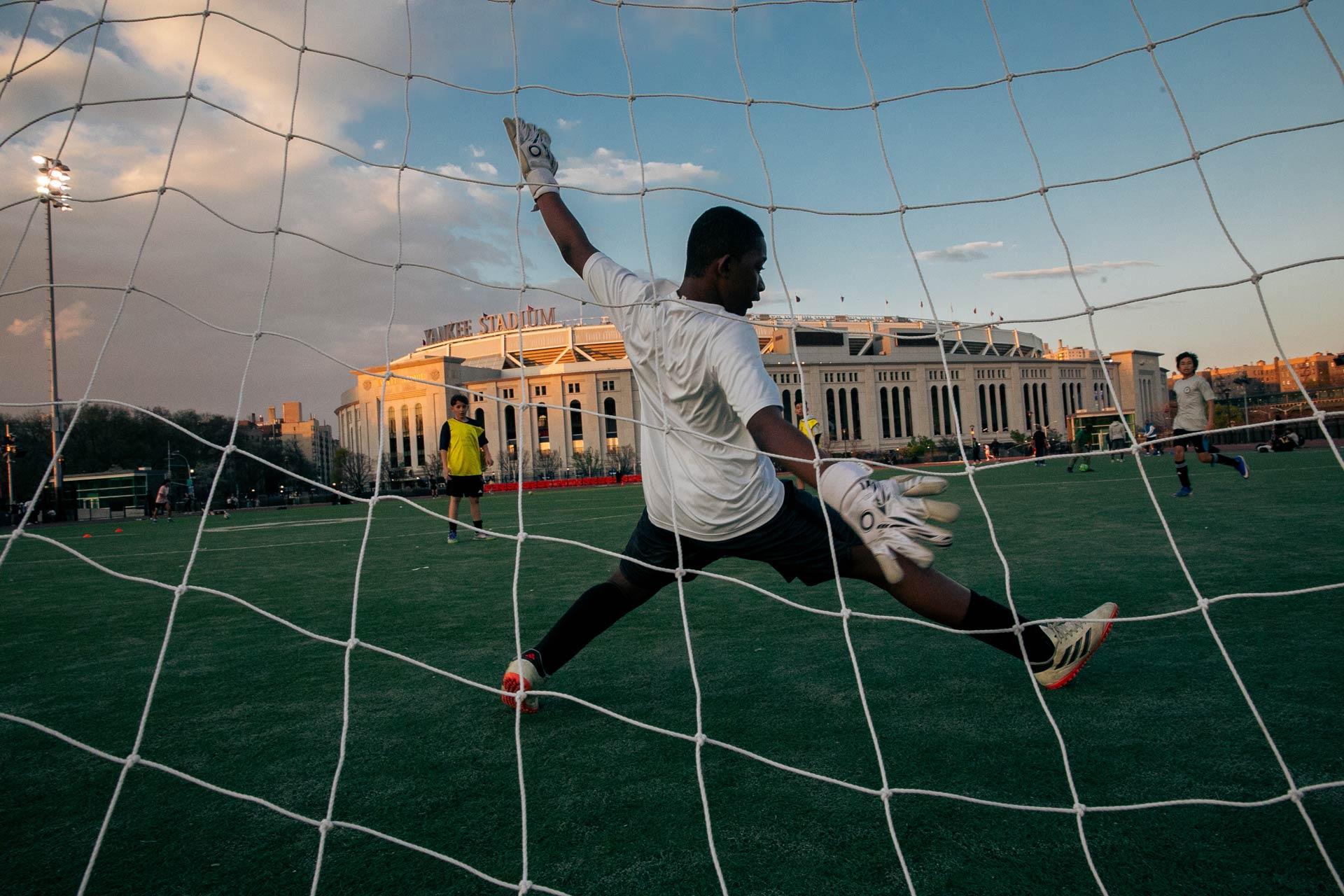
Students of South Bronx United playing at Macombs Dam Park, located near Yankee Stadium in the Concourse neighborhood of the South Bronx
While some clubs focus on success on the field, South Bronx United’s primary mission goes beyond the pitch. SBU offers playing pathways for kids of all ages, often from immigrant or first-generation families in the South Bronx, and provides them with support networks that help shape their future. Per the club’s mission statement, the club seeks to use soccer as a tool for social change. They approach this from several fronts, combining their youth soccer programs with academic enrichment, mentorship and even immigration legal services for their players and their families.
“There actually wasn't a team that gave kids a chance to get outside of the Bronx and compete,” says SBU Founder Andrew So. “It inspired me to start just giving kids a chance to continue to play, to give them access to sport, to get outside their community and access positive role models and mentorship. That was a key part of our mission from the beginning.”
This all-encompassing approach is paying off, with SBU Academy players all graduating high school and most going to college. This ongoing success story highlights the power of soccer when placed in the right hands with the right goals.


Andrew So


Founder of South Bronx United, Andrew So, with SBU students at Macombs Dam Park