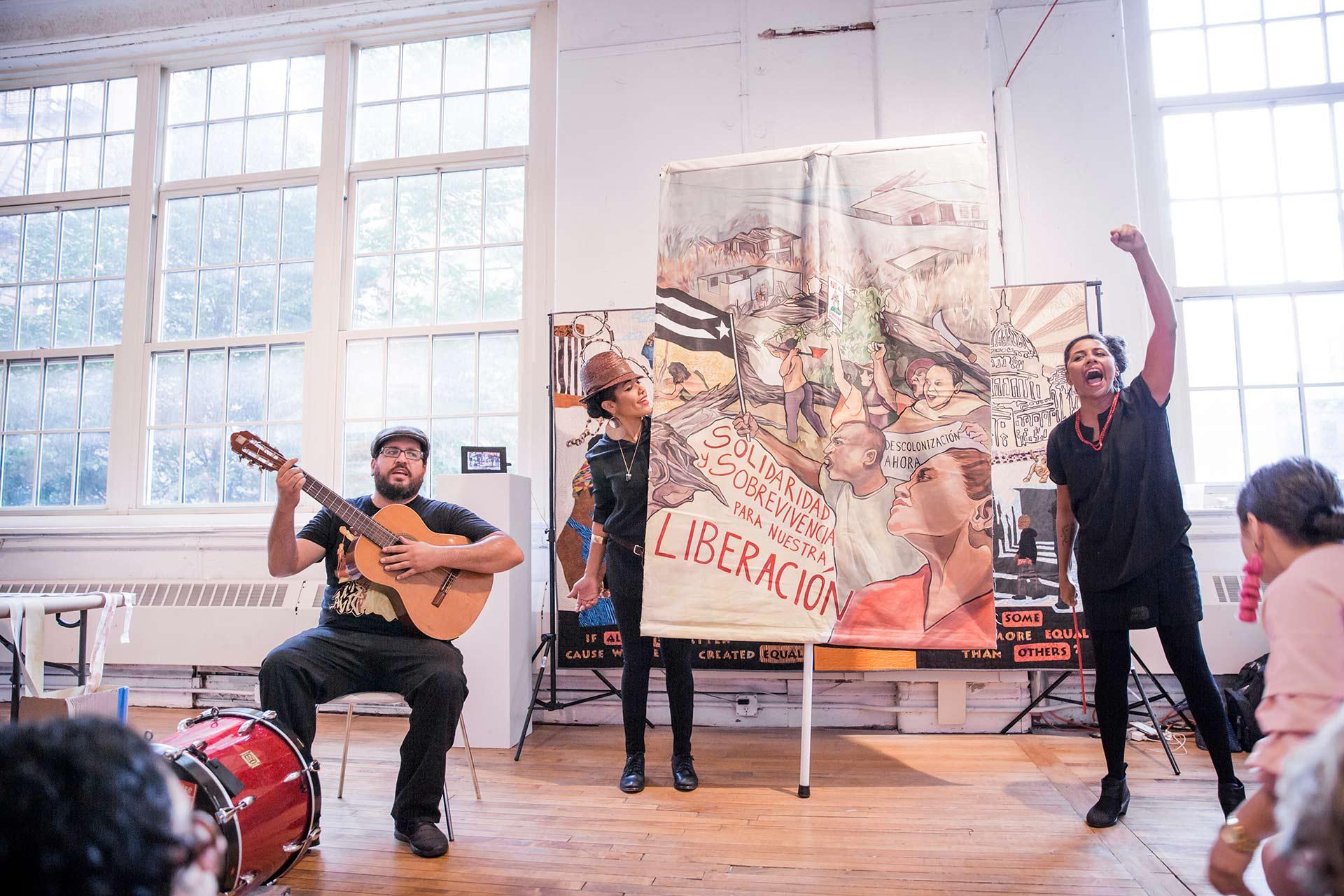
The Latino community of New York City plays a major role in the local arts and culture scene—and has done so for years. Latino founders and artists are behind many beloved museums, theaters, dance academies and educational centers. Latin American influence can be felt throughout the City, but certain neighborhoods are deeply rooted in the traditions of this culture. Consider a visit to Brooklyn’s Sunset Park and Bushwick, uptown Manhattan’s Washington Heights and East Harlem, and a stretch in downtown's East Village and Lower East Side known as Loisaida (historically centered on Avenue C). Each of these areas celebrates the culture through programming and community events.
Below we’ve highlighted 15 attractions and institutions that make a good starting point for anyone looking to dive deeper into local Latino culture. Check out these spots, along with some of the history and people behind each.

Ballet Hispánico. Photo: Paula Lobo
Ballet Hispánico
167 W. 89th St., Upper West Side, Manhattan
Founded more than 50 years ago, Ballet Hispánico is considered one of the country’s premier Hispanic and Latino dance companies, one that has helped connect audiences to the beauty of Latino dance. Over its existence, the company has commissioned more than 100 original works and continues to stage performances at its headquarters and other venues throughout the City. Ballet Hispánico is also home to a dance school that helps dancers as young as preschool age and up through adulthood develop a love for the art form.
Belongó
645 St. Nicholas Ave., Ste. 109, Harlem, Manhattan
Grammy-winning pianist, composer and educator Arturo O’Farrill founded the Afro Latin Jazz Alliance in 2007 as a nonprofit organization that celebrates the intersection of Latin jazz and other cultures. The organization’s new moniker, Belongó (which translates to “we belong”), underscores its drive to foster inclusivity and community. As Belongó has grown and expanded, so has its popularity and reach, having launched the Afro Latin Jazz Academy of Music in 2009 and the Fat Afro Latin Jazz Cats Youth Orchestra Program shortly thereafter; they eventually added online series and events. In 2026, the organization broke ground on Casa Belongó, at Park Avenue and 118th Street in East Harlem, further expanding its cultural footprint.

Courtesy, Bronx Academy of Arts and Dance
Bronx Academy of Arts and Dance
2474 Westchester Ave., Westchester Square, Bronx
The Bronx has been an incubator for many cultural movements, including hip-hop. In 1998, the Bronx Academy of Arts and Dance (BAAD!) became a pioneer in its own right, offering a welcoming environment for artistic expression to people of color, the LGBTQ+ community and women, led by co-founders Charles Rice-Gonzalez and Arthur Aviles. BAAD! is home to dance company Arthur Aviles Typical Theater and hosts a number of annual festivals, including Boogie Down Dance—the borough’s longest-running contemporary dance series.

Bronx Music Hall. Photo: Albert Vecerka
Bronx Music Hall
438 E. 163rd St., Morrisania, Bronx
Developed as a space to preserve and promote the borough’s rich arts legacy, Bronx Music Hall offers programming that emphasizes music and cultural traditions from the many diasporic communities that make up the neighborhood. While BMH is not solely focused on Latin American work, it’s a great place to catch Latin jazz, folk music, film, spoken word and visual art by artists from the Honduran Garifuna, Puerto Rican, Dominican and Mexican communities. Its co-artistic directors, Elena Martínez and Bobby Sanabria, have long associations with Latin music, movies and folklore studies.
Caribbean Cultural Center African Diaspora Institute
120 E. 125th St., East Harlem, Manhattan (CCCADI Firehouse)
208 E. 126th St., East Harlem, Manhattan (CCCADI Ilé Oyin–House of Honey)
African descendant communities—primarily from across the Caribbean—celebrate and preserve artistic, cultural and spiritual traditions at the Caribbean Cultural Center African Diaspora Institute (CCCADI). Panel discussions, art exhibitions, performances, film screenings and spiritual programming offer opportunities to connect across African diasporic communities. A new addition in 2025, Ilé Oyin (or “House of Honey” in Yoruba) is a hive for multidisciplinary artists to advance social justice initiatives.
Center for Puerto Rican Studies at Hunter College (Centro)
2180 Third Ave., East Harlem, Manhattan
Based out of Hunter College, the Center for Puerto Rican Studies (Centro) offers educational community events, including performances, exhibits, film screenings, panel discussions and workshops. History buffs can visit Centro’s library and make appointments to explore the archive—the largest in the US dedicated to the country’s Puerto Rican diaspora (with a special focus on New York City). While the organization renovates and expands (completion is expected in 2027), it will hold exhibitions and events in spaces throughout the building and with partner organizations. The institution will eventually have a new permanent gallery and a storefront for their online shop, La Bodega.

Courtesy, Clemente Soto Velez Cultural and Educational Center
The Clemente Soto Velez Cultural and Educational Center
107 Suffolk St., Lower East Side, Manhattan
Originally Public School 160, this building became a space for multipurpose organizations and, later, nonprofit community use with help from a 1970s resolution by Mayor Abe Beame, a PS 160 alum. The cultural center commemorates the spirit and legacy of Puerto Rican poet and activist Clemente Soto Velez, an advocate for Puerto Rico’s independence. The Clemente works to unite the wide range of cultures and ethnicities in the Lower East Side through the arts; its current initiative, Historias, focuses on past and present stories of Latino communities. Keep track of upcoming events here.

Courtesy, El Museo del Barrio
El Museo del Barrio
1230 Fifth Ave., East Harlem, Manhattan
El Museo del Barrio’s building on the northern end of Manhattan’s Museum Mile was once a fire station. The current space was established in 1969 after Puerto Rican parents, educators, artists and activists recognized a need for more representation of Latino artists. Today it’s the home of Latin American and Caribbean art—the oldest museum in the country dedicated to this group—and one of the City’s most beloved cultural institutions, housing a permanent collection of more than 8,500 objects that represent over 800 years of Latin American and Caribbean history.

Courtesy, Hispanic Society Museum & Library
Hispanic Society Museum & Library
3741 Broadway, Washington Heights, Manhattan
This museum and reference library aims to promote the cultures of Spain, Portugal and their former colonies in Latin America and the Philippines. The expansive collection includes more than 900 paintings and 6,000 watercolors and drawings. Among the notable artists whose works are on display are El Greco, Francisco de Goya, Joaquín Sorolla and Diego Velázquez. The library contains more than 250,000 books, plus works on paper, photographs and prints. In addition to its exhibitions and permanent collections, the museum hosts tours, reading and educational programs, as well as a concert series.

Courtesy, Institute for Studies on Latin American Art
Institute for Studies on Latin American Art
142 Franklin St., Tribeca, Manhattan
Founder Ariel Aisiks created the Institute for Studies on Latin American Art (ISLAA) to help fill the gap in representation of lesser-known Latin American artists across museums and galleries. ISLAA takes on a stewardship role for artists’ collections—housing and cataloging artwork, letters and personal items to make them available for researchers and curators. Not only does the organization partner with art institutions and universities to ensure these stories are told, but ISLAA also hosts several exhibitions throughout the year that focus on modern contemporary artists from Latin America—many in the diaspora in the US.

Courtesy, Nuyorican Poets Cafe
Nuyorican Poets Café
236 E. 3rd St., East Village, Manhattan (currently closed for renovations)
The term Nuyorican, a combination of New Yorker and Puerto Rican, represents a fusion between those two cultures—in part referring to a literary and arts movement that emerged in the 1960s and ’70s after increased Puerto Rican migration. Though the Puerto Rican community makes up a large part of NYC culture today, integration into city life has not always been easy. The founders of the Nuyorican Poets Café—Miguel Algarín, Miguel Piñero and Pedro Pietri—believed that art could bolster social and political justice, a conviction that took the form of poems, plays and other literary compositions. Those brave enough should try one of the café’s open mic nights (currently online or at partner venues), where you have up to four minutes to share your poetry with the audience. Note that the venue has been undergoing an extensive renovation since 2023 and has yet to reopen in its permanent location. Meanwhile, they continue programming at area venues; find the calendar of activities here.
The People’s Theatre: Centro Cultural Inmigrante
419 W. 206th St., Inwood, Manhattan
Though The People’s Theatre: Centro Cultural Inmigrante opened its doors in September 2026, the organization has been telling immigrant stories through multilingual theatrical works since 2009. Hamilton creator Lin-Manuel Miranda—who was at the ribbon cutting—is among the many supporters who helped bring the Latino-owned organization’s permanent home to fruition. Welcoming visitors with Scherezade García’s Liquid Highway mural, it’s a place for audiences to experience theater, music, dance, film and educational programs highlighting the Latino community and other immigrant groups.

Repertorio Español. Photo: Michael J. Palma
Repertorio Español
138 E. 27th St., Gramercy, Manhattan
Founded in 1968, this theater features Latin American– and Spanish-themed shows with English subtitles. Repertorio attracts talented veterans and emerging Hispanic actors, including Yolanda Arenas and Ofelia González, the first actress to win an Obie without performing a word in English. Performances like La Casa de Bernarda Alba by Federico García Lorca and La Gringa by Carmen Rivera can be seen online here.

Jaime and Javier Suárez, Memoriam, 2023. Photo: Monica Felix
Taller Boricua
1680 Lexington Ave., East Harlem, Manhattan (Taller Boricua Gallery)
215 E. 99th St., East Harlem, Manhattan (Rafael Tufiño Printmaking Workshop)
Taller Boricua (pronounced tah-YEHR boh-REE kwah) focuses on the intersection of art and activism, having developed out of the political upheaval in 1969 that called attention to the City’s neglect of East Harlem. One of the longest-running Puerto Rican artist collectives in the country, the organization’s original mission of platforming artists through posters, outdoor exhibits and cultural programs remains at its heart. Exhibitions and events showcase underrepresented and marginalized creators, while the Rafael Tufiño Printmaking Workshop is a space for members to create—and occasionally for the general public to take a class.

Tito Puente Way. Photo: David 'Dee' Delgado
Tito Puente Way
East 110th Street from Fifth to First Avenues, East Harlem, Manhattan
Jazz and mambo composer Ernest Anthony “Tito” Puente Jr., a seven-time Grammy winner (including a posthumous award), is often referred to as the “King of Latin Music.” Puente was born in 1923 at Harlem Hospital and spent his early years living on 110th Street. Just a few months after Puente’s passing in May 2000, the stretch of East 110th Street between First and Fifth Avenues was renamed Tito Puente Way. You can visit Puente’s memorial at the corner of Fifth Avenue and 110th Street, just down the street from where the musician once lived.
Discover more stories in our Latino Experience guide.