Photographer Meryl Meisler spent the late 1970s documenting New York City nightlife, an experience that coincided with her embrace of her queer identity. Moving easily between legendary clubs like Studio 54, the Copacabana and the City’s queer-friendly discos, she photographed celebrities, performers, dancers and everyday clubgoers with a keen documentarian eye. She did not consider herself a professional photographer, but rather someone who simply brought her camera along on nights out.

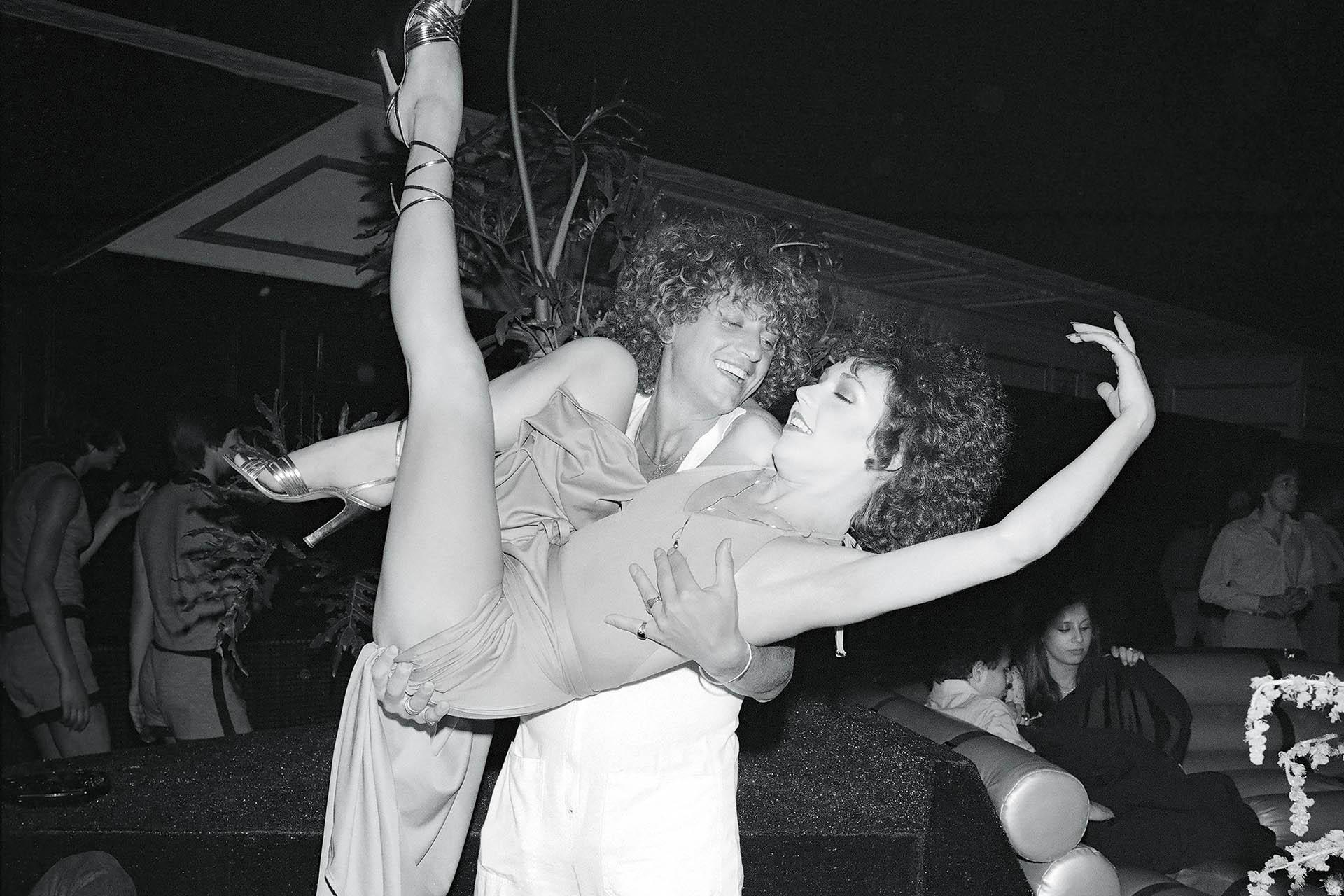
John (Just) Contini's Raised Arm, Brooklyn Summer Soiree, Copacabana, NY, NY, August 1977
After the 1970s ended—along with her 20s—she shifted into a more settled life, becoming a schoolteacher and entering a long-term relationship. Little by little, the glitz and glamour of the club scene faded into memory. But through a series of kismet encounters in the mid-2000s, her photographs, long stored away in boxes, began to see the light again. They have since been rediscovered and published in a series of books and gallery shows.
We talked with Meisler, now in her 70s, about nightlife as a young queer woman, the fellowship she found there and how the same sense of performance, self-invention and community that first drew her to the clubs exists in NYC today.

Pyramid Entrée Heat, NY, NY, April 1979
Carol Joo Lee: As a queer woman in the 1970s, what did New York nightlife and the club scene mean to you? What did those spaces make possible for you personally and creatively?
Meryl Meisler: I came out in 1975 and began immersing myself in New York’s nightlife a couple of years later, just as the disco scene was taking off. What drew me to it was that it felt like live theater—music, performance, spectacle and an incredible mix of people of different ages, races and backgrounds. The queer-friendly atmosphere was especially important to me because those spaces felt open and expansive.
Creatively, I was inspired by Brassaï’s photographs of 1930s Paris nightlife and realized, This is my Paris. I started bringing my camera with me, so going out became both a social and artistic experience. I was dancing, meeting people and having fun, but I was also looking, observing and photographing.

Leaning on Car Outside Studio 54, NY, NY, October 1978
CJL: What were some of the queer clubs you frequented back then?
MM: What drew me wasn’t necessarily “queer clubs” as a separate category, but clubs that were queer-friendly—places like Studio 54, Infinity, Hurrah, Les Mouches and even the Copacabana. I also went to the Palladium and the Mudd Club. Of all the places I frequented, GG’s Barnum Room was probably the most predominantly queer and had a large community of trans women and gender-nonconforming people. The disco scene, at its best, welcomed people of different identities and backgrounds and gave them the freedom to be who they wanted to be. That’s what made those spaces so special.

Judi Jupiter Photographing Dancers, GG’s Barnum Room, NY, NY, December 1978
CJL: Looking back, did you find your muse in particular people or places? What drew your eye—then and now?
MM: The night itself became a muse. I was fascinated by the dancers, the DJs, the friendships and the spontaneous moments unfolding around me. I was working as an illustrator at the time, so I knew how to tell a story. I was always composing the background and the people within it, paying attention to how they fit together in the frame.
Some people appear again and again in the photographs, including my friend Judi Jupiter, who dressed very flamboyantly, whereas my style was more a preppy college girl. [She] made a great subject. [There was also] a performer named Dallas. She was very talented and very warm.
I wasn’t particularly interested in chasing celebrities. I was more drawn to the people who gave the scene its energy. I loved photographing people expressing joy, confidence, humor and individuality. The impulse to observe and capture those moments remains central to my work. The difference is that today I go out with the intention of photographing. Back then, I was going out to live the experience.

JJ Holding Head as Hair Flies While Dancing with Judi Jupiter, Studio 54, NY, NY, July 1977

Dallas Performs Near Mirrors, Hurrah Wild Wild West Party, NY, NY, March 1978
CJL: You seem to have had remarkable access to the people and places you photographed. Did you have a favorite club to photograph?
MM: Studio 54 was certainly one of my favorites, but what I loved most was the atmosphere the clubs created. I loved the architecture, the lighting, the themed nights, the costumes and the sense that an entire space could be transformed into a kind of theater. Because I was a regular at many of these clubs, the staff and other clubgoers knew me, and I naturally developed friendly relationships with them.
CJL: What are some of your most unforgettable memories?
MM: One unforgettable night was Valentine’s Day 1977 at the Copacabana, at an event called the COYOTE Hookers Ball, organized by Margo St. James. I went alone, wearing my old Girl Scout uniform, and was completely blown away by the crowd: trans people, sex workers, drag performers, gay men, straight couples, paparazzi—an extraordinary mix of people I had never seen together in one space before. It felt electric, theatrical and radically open. That night was the moment I realized, I love this world and I want to keep coming back to it.

Andy Warhol Smiling with Eyes Closed (Between his Friend and Judi Jupiter) Studio 54, NY, NY July 1977
Another memorable evening was Bella Abzug’s birthday party at Studio 54 in July 1977, shortly after the New York City blackout. The room was an incredible mix of politicians, feminists, artists, celebrities and nightlife regulars—people like Andy Warhol, Shirley MacLaine, William Shatner and Gloria Steinem. What struck me was the contrast. Only days after the City had felt chaotic and dark, here was this exuberant gathering of people from completely different worlds, all sharing the same room. It was the kind of night that makes you feel the magic of the City.
CJL: People often remember the 1970s through a glossy lens—pleasure, glamour, dancing, excess, sexuality. But your photographs also capture melancholy, boredom and exhaustion. Were you consciously interested in holding those emotional contradictions together?

Patou and The Man in The Moon With a Cocaine Spoon Studio 54, NY, NY. August 1978
MM: I wasn’t consciously trying to create contrast so much as document what I saw. Looking back, I think that’s part of what gives the work its depth. I was interested not only in the glamour of nightlife, but also in the human moments unfolding beneath it.
During 1978 and 1979, I received a CETA grant and worked as a documentary photographer for the American Jewish Congress, photographing Jewish New York during the day. At night, when I photographed my own adventures in the clubs, I brought that same observing eye to the work.
In that sense, there are echoes of Weegee’s work—only instead of crime scenes, I happened to capture the disco scene.

Rejected From Studio 54 No No (With Judi Jupiter), Studio 54, NY, NY, October 1978
CJL: In Rejected from Studio 54 No No [pictured above], are the policemen real officers or people in costume? And how did that photograph come together?
MM: Those were real police officers. It was a night when the doorman, who was usually friendly with us, decided not to let us in. I gathered some of the other rejects along with the policemen who happened to be standing there and took the photograph. Judi Jupiter is the woman posing. Looking at it now, the policemen look so wholesome, don’t they?
We ended up going to GG’s Barnum on West 45th Street, just a few blocks away. Our attitude was that if one club says no, move on to the next.

Prom Queen Contender, Les Mouches, NY, NY, June 1978
CJL: Can you talk about what’s happening in Prom Queen Contender [pictured above]? It’s such a layered image: the glamorous drag queen at the center, the women who look like 1950s prom queens and the men—some suited, some shirtless—focused on her. The photograph seems to capture shifting ideas around gender, performance and desire all at once, almost emblematic of the decade itself.
MM: This photograph was taken at a prom-themed party at Les Mouches, an invitation-only disco on Eleventh Avenue in Chelsea. The crowd was a mix of gay and straight clubgoers. What you’re seeing is a group of contestants and onlookers gathered before the Prom Queen and Prom King competition. Some of the women looked ready for a 1950s sock hop, while some of the men looked like John Travolta in Saturday Night Fever, especially the man dressed all in white.
The drag queen looks especially modern next to the bouffants and pearls. In fact, a burlesque performer recently saw the photograph and assumed it was contemporary because she owned the same style of high heels.

PAPARAZZI Ron Galella photographing Dangerfield at Send in the Clones Party, Les Mouches, NY, NY June 1978
CJL: Another striking image is of Ron Galella photographing a dancer, with “Paparazzi” emblazoned across the back of his jacket [pictured above]. It makes me think about how different photography culture was then.
MM: A lot of people assume I was the only photographer in the room, but there were actually dozens at many of these events. Their pictures appeared in newspapers and magazines, and that’s how I knew who Ron Galella was. I loved the irony of photographing him in a jacket that said “Paparazzi.”
I also like that the photo captures more than just Ron—the dancer, the phone booth and the people along the side of the room. Someone like Ron had press credentials, but I never did. I was simply there with a camera. If I found myself standing next to a celebrity like Andy Warhol, I could just ask to take a picture. What’s changed is that everyone has a camera now, yet in some ways photography is more restricted, since many nightlife spaces discourage it and celebrities are more guarded.

Grace Jones Sitting Upon Couch on Opening Night, Le Farfalle, NY, NY, June 1978
CJL: Now, from a distance of more than 40 years, what is your impression of the 1970s?
MM: I grew up on Long Island, and when I moved to New York, although I was previously scared of it, I immediately knew it was home. The 1970s felt like a cauldron of energy, diversity, and change. It was also a time shaped by major cultural shifts: post-Stonewall, women’s liberation and big changes in fashion and identity.
In retrospect, it feels more innocent in light of what followed—the AIDS crisis, 9/11. The City changed through those events, and my own life changed too. I became a schoolteacher, entered a relationship and went out less.
I didn’t realize at the time that we were living in the epicenter of nightlife culture. Revisiting the photographs decades later—and returning to photograph nightlife again—made me appreciate how special New York nightlife was, and still is.

DJs Spinning at Le Farfalle's Opening Night, Le Farfalle, NY, NY, June 1978
CJL: Although you continued taking photographs throughout your adult life, much of your work remained unseen for decades. What has it meant to have younger generations discover and embrace it?
MM: Having my work rediscovered has been a dream come true, and it fills me with gratitude. It began in 2006 when a stranger emailed me looking for photographs of Bushwick in the 1980s. That prompted me to start digging through boxes of slides that had been sitting in storage for decades.
After I retired from teaching in 2010, I had more time to focus on the archive, which led to one exhibition after another. One of the chance encounters was meeting filmmaker Jean-Stéphane Sauvaire, who owned the Bushwick club Bizarre. I was initially hesitant when he asked me to show my disco photographs there, but I soon realized that Bushwick had become the place to be and was the perfect setting for the work.
CJL: What catches your eye these days? Is there a contemporary equivalent—your “Studio 54 of 2026”—that excites your curiosity?
MM: Since returning to nightlife photography, I’ve been drawn to queer-friendly spaces like House of Yes and Susanne Bartsch‘s parties. What interests me is seeing what’s remained the same and what’s changed. There’s still that sense of performance, self-invention and community that first drew me to the clubs, but I’m also seeing new forms of gender expression and new generations creating their own scenes.

Disco Sally Taking a Break From Dancing, Les Mouches, NY, NY, June 1978
What’s funny is that in the 1970s there was a woman known as Disco Sally, a widow in her late 70s who was always out dancing. I saw her all the time. When I was turning 30, I remember wondering, Do I really want to be the old lady at the disco?
But after returning to nightlife photography in my 70s, I finally understood her. People now recognize me and ask to see the pictures I’ve taken. I tell them, “You can’t—it’s film.” I get Disco Sally now. She simply loved being there.
Carol Joo Lee is a freelance writer with experience in journalism, contemporary art and research. She recently co-founded Bonnyhood, a nonprofit supporting people affected by 9/11-related illnesses, and is currently writing a film novel with her partner.
Photographer Meryl Meisler’s muse has been New York City since moving here in 1975. A former public school art teacher, Meisler has a vast archive of images from the 1970s and ’80s—work marked by a deep sense of place, humanity and a distinctly queer eye. Meisler is again photographing nightlife in her ongoing project, Queer-Friendly Nightlife Now. For more work, follow Meryl Meisler on Instagram.