In New York City, just a few subway stops can transport you to different worlds—from the electric pulse of Midtown Manhattan to quieter corners of the boroughs where cultures converge. Our Founded By NYC film series, “From Times Square to the World,” explores how the City has shaped and been shaped by the people and stories that make New York “New York”—and how easy all of them are to access right from Times Square. Along the way, we celebrate the vibrant past and ever-evolving present that make New York a city that’s always making history.
New York wasn’t just shaped by immigrants—it was built by them. From Italy and Puerto Rico to China, the Caribbean and beyond, each wave of newcomers arrived bearing traditions, skills and dreams—pieces of homelands from across the globe that have been woven into the City’s fabric. Today, that legacy lives on in the language, architecture and rhythm of NYC’s daily life. Each stop on this route offers a window into the communities that turned NYC into the kaleidoscope of cultures it is today.

Connect with Native Heritage at the Smithsonian’s National Museum of the American Indian
After a roughly 20-minute ride on the 1 train from Times Square to South Ferry station, begin your day in Lower Manhattan at the Smithsonian’s National Museum of the American Indian, where past and present Indigenous voices come together in powerful conversation. Housed in the stately Alexander Hamilton US Custom House—a Beaux-Arts landmark that once oversaw the flow of global trade—the museum offers more than artifacts. It provides an immersive experience into the enduring cultures, resistance and creativity of Native peoples across the Americas. All of the exhibitions are developed in deep collaboration with Native tribes, ensuring that every object and story is shared with respect and authenticity.

Native ironworkers (left) and a hard hat worn by Paul Tripp (Six Nations Mohawk), featured in the museum's Native New York exhibit
Visitors can enjoy interactive exhibits, including a game that simulates trading using Native methods, and explore New York State through a walking tour map. As you move through galleries filled with intricate beadwork, evocative photography and contemporary installations, you’re reminded that Indigenous presence in the City is not just historical—it’s ongoing. A powerful example of this is the enduring impact of the Mohawk ironworkers from Kahnawake and Akwesasne, who helped shape Manhattan’s skyline. Known for their skill and fearlessness, they played vital roles in building some of the City’s most recognizable structures—including the Empire State Building and, more recently, One World Trade Center.
From the museum, head south toward Battery Park to reach Whitehall Terminal (also known as South Ferry). Hop on the Staten Island Ferry for a free, scenic 25-minute trip across New York Harbor—keep an eye out for views of the Statue of Liberty and Ellis Island. Once you arrive at the St. George Ferry Terminal, your next stop is just a five-minute walk away.

In the kitchen at Enoteca Maria
Taste the World Through Grandmothers’ Recipes at Enoteca Maria
Make your way to Staten Island to experience Enoteca Maria, where the chefs are a rotating lineup of grandmothers from around the world. Each night, a different nonna steps into the kitchen to share the flavors of her homeland—one evening, you might find Nonna Irene from Puerto Rico preparing pastelón by hand, the next, it’s Nonna Yumi from Japan rolling fresh udon. But the energy remains the same—warm, familial and deeply rooted in heritage. Founded by Joe Scaravella as a tribute to his own grandmother’s Italian kitchen, Enoteca Maria has grown into a global celebration of home cooking.
Grab a glass of wine, watch the nonnas work in the open kitchen and chat with fellow diners—many of whom are regulars who come for the surprise of what’s on the day’s menu. In a city built by immigrants, Enoteca Maria is a love letter to matriarchs and the food traditions they carry with them.
Take the ferry back to Manhattan, then head to the Brooklyn Bridge–City Hall station and catch the 6 train one stop uptown to Canal Street.

Timothy Hsu, Chinatown Soup
Slow Down and Sip: Tea Meditation at Chinatown Soup
Step into Chinatown Soup, a creative hub nestled in the heart of Manhattan’s Chinatown, and you’ll find more than an art gallery—it’s a living continuation of a long-standing community spirit rooted in resilience, creativity and care. One of its quietly transformative offerings is a tea tasting and meditation with Timothy Hsu, a ritual that invites guests to sit in stillness and share tea. Rooted in traditions that date back to the Tang dynasty, Hsu’s meditations offer a rare kind of quiet—each cup becomes a pause, each sip a moment of reflection and each session a small act of resistance to the City’s relentless pace.
For Hsu, this work is deeply personal. His family has long been connected to community organizing in Chinatown. In the 1970s, when the neighborhood was plagued by gang violence and instability, a grassroots collective called Basement Workshop was formed by artists, actors and local activists—including John Lone, Tzi Ma and Hsu’s aunt. The group created a safe space where young people could gather, learn and express themselves through art, performance and politics.

Chinatown Soup continues that legacy—creating space not just for community, but with community. The space was co-founded with Michelle Marie Esteva, Tim’s partner, who saw the need for an inclusive, experimental hub that honors Chinatown’s roots while cultivating its creative future. Together, Michelle and Tim have shaped Chinatown Soup to be a home for emerging artists and local programming. Whether you come to see new artwork, join a neighborhood initiative or simply sit for tea, you’ll experience a living tribute to the generations who built and protected this neighborhood—and to those still dreaming within it.
From Chinatown Soup, walk to the Grand Street station and catch the B train uptown to 145th Street. Transfer to the D train and ride to Fordham Road station. Just a short walk from there is Arthur Avenue—known as the Bronx’s Little Italy.
Explore the Flavors of Arthur Avenue
Arthur Avenue is a treasure trove of specialty shops, time-honored markets, and generations-old eateries that continue to thrive in the Bronx. While its roots lie in the wave of Italian diaspora who settled here in the early 20th century, today the neighborhood is a vibrant mosaic of Italian, Albanian and Puerto Rican people—a living tapestry of the City’s ever-evolving identity.
Begin your journey at No Fork, a modern addition to the Arthur Avenue scene, where owners Artir Hyseni and Veton Sinani put a Balkan twist on classic Italian-American fare. The menu features hearty sandwiches, pizzas and samuna (Albanian pita) made with flaky sesame crust and creamy Zdenka cheese, a nod to his family’s Kosovar roots. The name "No Fork" hints at the street food-style approach that invites you to dig in, using your hands. It’s a fitting symbol of how new communities continue to shape the Bronx’s culinary landscape.

Calabria Pork Store
Next, make your way to Calabria Pork Store, a third-generation, family-run gem operated by the Grandinetti family. It’s known for its fiery ’nduja sausage and iconic “meat chandelier,” a ceiling display of hundreds of house-made soppressata hang from the ceiling. Opened in 1973 by Nicola and Marisa Parrotta, who immigrated from Calabria (the Parrotta family still runs the place), the store preserves age-old Italian pork-curing methods that are rarely seen outside of Italy.
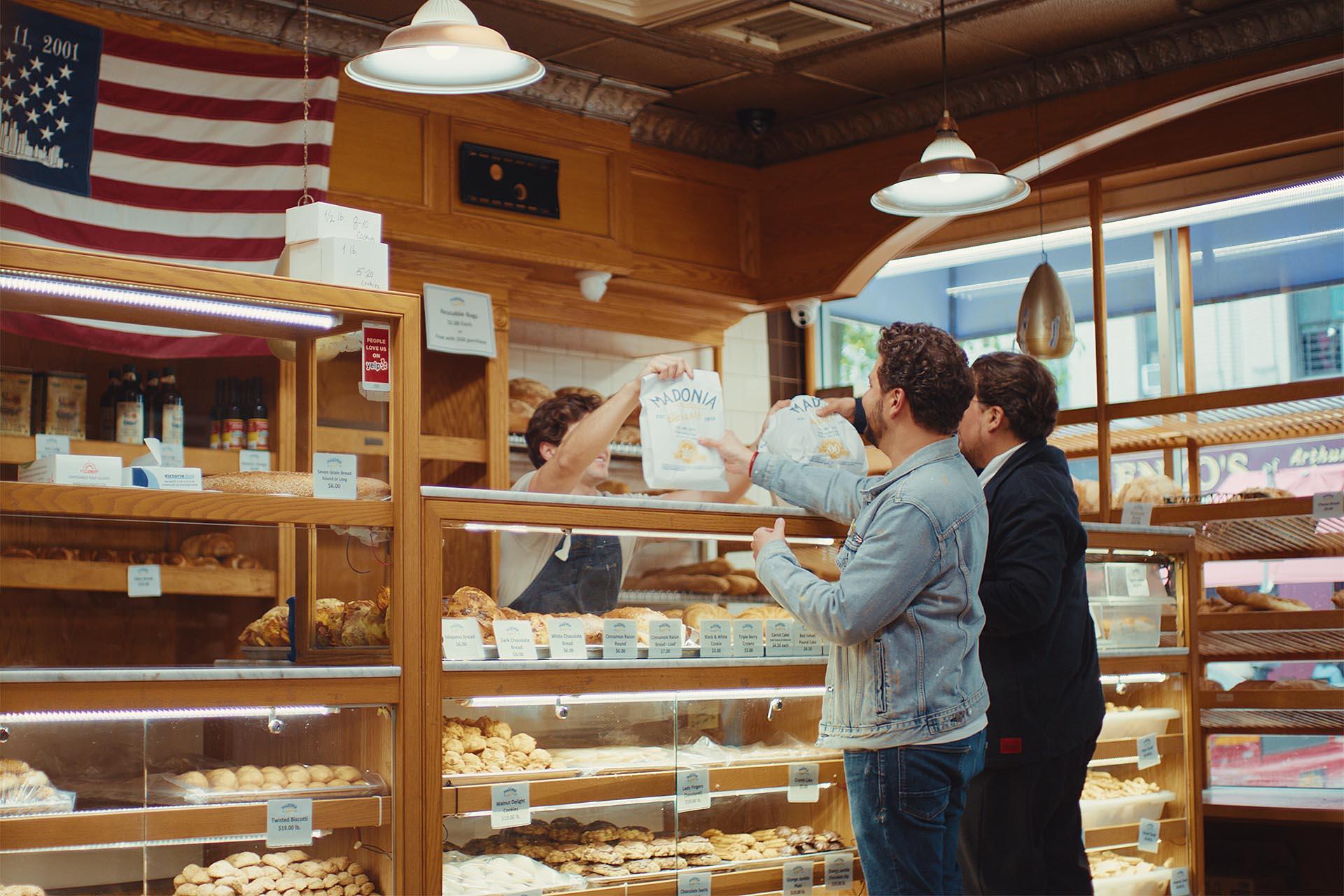
Just down the block, follow the scent of warm bread to Madonia Brothers Bakery, a Bronx institution since 1918. Still run by the Madonia family, now in its fourth generation, the bakery prepares its signature breads daily and is beloved for its classic Italian loaves, biscotti and especially its cannoli—a perfect blend of crisp shell and creamy ricotta filling.
Then, head to Cosenza’s Fish Market, another Arthur Avenue cornerstone that’s been operating since 1918. Founded by the Cosenza family, this market began as a modest pushcart business, delivering freshly caught seafood from the Atlantic to Bronx residents. Today, the legacy continues with a street-side raw bar where you can slurp oysters and clams shucked to order.

The Bronx Beer Hall
End your day at The Bronx Beer Hall, tucked inside the historic Arthur Avenue Retail Market. The Beer Hall was founded by Puerto Rican brothers Paul and Anthony Ramirez, who wanted to create a space for locals and visitors to gather, and celebrate the Bronx over a pint of craft beer. With rotating taps featuring Bronx-born breweries and a menu of market-sourced bites, the Beer Hall is more than just a place to raise a glass—it’s a community hub where stories are shared, friendships are forged and the borough’s spirit comes alive.
For more itineraries and to see the rest of the series, visit our From Times Square to the World hub.


