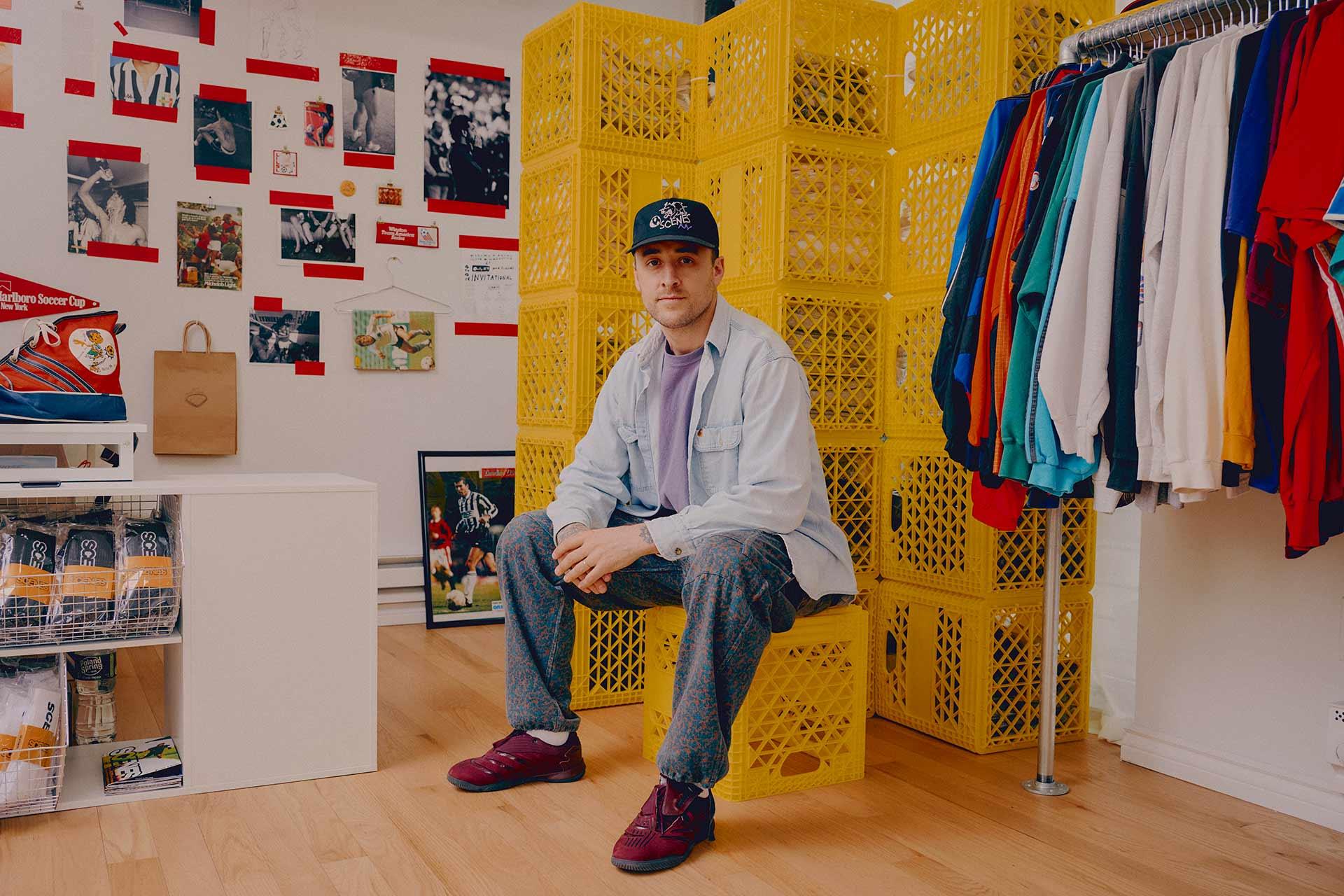
Lucas Capozzi-Shanks is the founder of Scenes NY, a brand that recently moved from a studio to a storefront in Greenpoint and specializes in unique soccer vintage and their own range of teamwear. Outside of his day job at a creative agency, Capozzi-Shanks been a part of the NYC soccer community for almost two decades. After college, he moved to NYC and began playing for the Manhattan Kickers in the CSL as well as in the Bowery Premier League. “Soccer just took over as my social network, the structure to my life and now more of my work life,” Capozzi-Shanks says. Over the years, soccer became a catalyst for him to build community in the City.
“Part of making New York stick for me was this network that I created. Soccer in the City exposed me to players who were also writers, art directors, artists, producers, photographers and designers. And some people in finance or whatever. But the crossover of sport and creativity is very strong in New York."
We sat down with Capozzi-Shanks to discuss his recently opened shop, soccer’s influence on the City’s style, what soccer culture really is in NYC and how it drives the sport across the country.


How did Scenes NY start?
Lucas Capozzi-Shanks: [Scenes NY] originally started as a curated monthly newsletter, where I dug into little rabbit holes of sports ephemera: the way former players dressed, their politics, interests and the things that made them a cool person outside of being a world-class footballer.
The newsletter quickly evolved when I started digging deeper into vintage. I’ve always been an eBay rat, for lack of a better term. The vintage became this endless sea of exploration of clubs, countries, their badges, backstories and their traditions and cultural contexts.
The vintage took off, and I got to a point where I was like, “OK, I have this little obsession starting. Where does it go?”
I need to take these vintage pieces and really look at them. I need to dissect them. I had, like, 250 pairs of shorts one summer, all Umbro, Diadora, Lotto, Adidas, Nike—some from the ’80s, most from the ’90s and a little bit of the 2000s.

I started to learn how the elastic wore out after a long time, and if you let it sit for 10 years and then you stretch it, it all comes apart. I started taking them in to get refurbished. I would wear them all the time and think, “Well, I don’t like that these don’t have pockets. I have shit to carry."
So I tried to manufacture a pair of soccer shorts in New York City. Imagine me, running errands around the Garment District like a fashion student. I’m not gonna say the pair I made was perfect, but it was, functionally, exactly what I needed to be a soccer player in New York—which is a pair of perfectly short, sexy nylon soccer shorts that look and feel and flow like they used to, but with pockets.
Now, our store has a small vintage catalog that still inspires the things we make, the silhouettes that we build and designs we develop, as well as a lot of our graphics.

And why is it called Scenes?
"Scenes" is British slang. It’s when a stadium goes crazy, when something insane happens, it’s “absolute scenes.” It captures a moment of chaos. I took that name intentionally. For me, Scenes is about recapturing an unapologetic attitude and spirit of American soccer that existed throughout the ’80s, ’90s and early 2000s that a lot of people don’t really know was there. It’s an era of American sports that I think should be celebrated.

How would you describe the community at Scenes NY and how does it inspire you?
LCS: People who see the game through the same lens as we’re creating it are the community. There’s a certain type of person who uses soccer as this grounding, foundational part of life. Living and working in New York City is an absolute grind, but your pickup games and your practices and your league games and the times you go to the bars to watch games together become backbone and the metronome and the rhythm of your life. It obviously keeps you fit and active, but it also keeps your creative spirit alive.
It makes me happy when I show up to a pickup run or a league game and see someone wearing our socks or a pair of our shorts, maybe even wearing a vintage tee or hat from our catalog at the bar after, or completely outside the context of soccer. I like to see the brand as a reflection of the people who show up to play in this city, and continues to inspire people who shape their life and identity around the world’s most popular sport.

How has soccer influenced fashion and streetwear in NYC?
LCS: I don’t think you can go about life wearing basketball gear or American football gear or hockey gear or baseball gear. It kind of looks like you’re in a costume. The thing about soccer gear is that it’s great apparel. It’s perfectly fitting shorts. It’s nice shirts. Boxy tops. Good, uniform colors. The look and the feel of soccer gear effortlessly blends into personal style a lot easier and in less obvious ways, but still be culturally identifying. Soccer gear can look good and considered without trying too hard and New York City loves that.

How is soccer culture expanding in the US and in NYC? How is NYC driving the expansion of soccer in the US?
LCS: New York drives the expansion of most culture. It doesn’t matter the industry or the category. Soccer is no different. New York proves soccer’s staying power in America. The City and the sport both thrive in small pockets of space, and because of that the sport can create subcultures on the streets and on small turf pitches. Those pockets are becoming bigger, more powerful and more influential on the global game, and you’re starting to see it throughout the rest of the country. New York City is a case study on how a sport normally played on big fields can not only survive in a congested environment, but captivate and cultivate entire communities.

How is soccer culture different in NYC than in Europe?
LCS: I will just say I think it’s better. I’m not speaking for America; soccer culture in New York City is better than it is in Europe. I’ll say that. Print it. We have the benefit of having an incredibly diverse population of soccer fans living closely together, and I think that allows people to more quickly be exposed to different expressions of the game, not just from Europe, but Central America, South America, Africa and Asia.
We’re not burdened by the stodgy, conservative traditions of the UK and Europe. I think they’re very fussy about their football, and that creates a lot of guardrails. There’s been organized soccer in this city since it has existed. And while New York City is unique because it’s a melting pot of global football traditions, it still exists on the fringes of American culture.

Who are you paying attention to in soccer these days?
LCS: The people keeping the dream alive. Chinatown Soccer Club, they’re kind of the OG, like 25 years, multiple pickup runs per week between creative professionals and downtown legends. Bowery FC, same thing, decades of organized pickup, but I love the way that they present themselves as a club to the world. And Secret Futebol Club. They do almost daily pickup runs that people can just kinda rock up to, it's very democratic. They have a cool approach to community and how they incorporate art and music into their soccer world.
The coolest thing you can do is cultivate a space for this sport to happen on a grassroots level, and you build traditions around it.
What do you think the future of soccer is in NYC?
LCS: There’s a lot to say about soccer in New York. We have two professional MLS clubs, one [NYCFC] that’s about to build a new stadium in Queens that I think will change the way that people experience game day.

Gotham FC, from the NWSL, are reigning champs. Some of the biggest names in women’s soccer are on that team. The New York Cosmos are returning, and there’s a USL club now in Brooklyn, Brooklyn FC, and there are academy teams and these lower-level professional teams all around the tristate area. It’s just peppered with talent. But that’s the capital S soccer. Having that exposure definitely raises the ceiling.
But the grassroots cultural side of the game embodies the passion and the hustle you need to live and play soccer in the City, and grow the sport organically. That’s the identity that I think is going to take over soccer in America, and I think it comes from New York.