
This article is a companion piece to One Dish, our social series showcasing NYC chefs and their best-known dishes. This season is hosted by Justin Wu (@hungryartistny) who creates illustrations of his favorite NYC eats. Watch the video on our Instagram page.
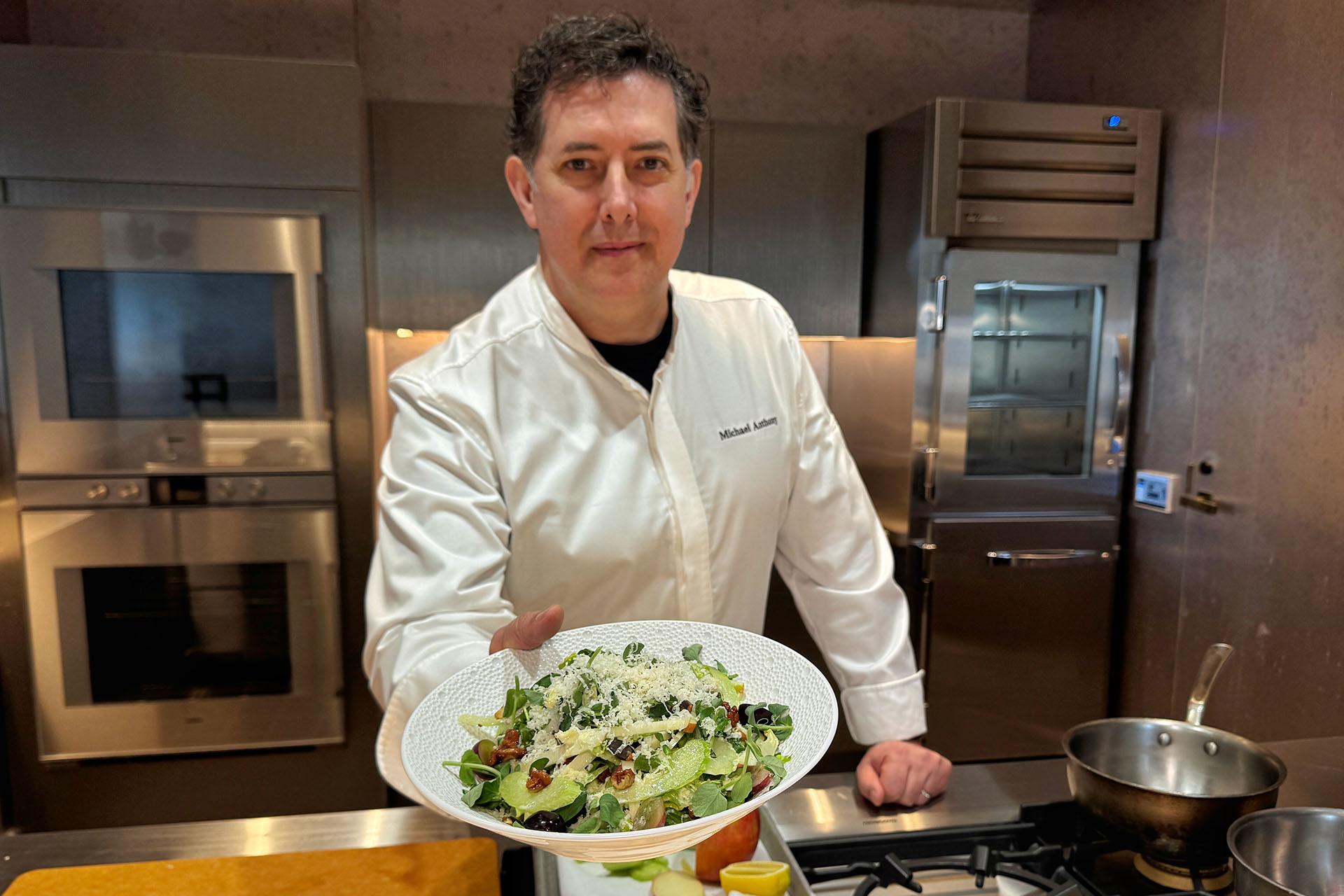
If there is one dish at Lex Yard that helps bridge the Waldorf Astoria New York’s past and present, it's Chef Michael Anthony’s reimagined Waldorf Salad.
The Waldorf salad is a fixture of New York City dining. First appearing in The Cookbook by “Oscar” of the Waldorf, an 1896 collection published by the hotel’s maître d’, Oscar Tschirky, the recipe combined a handful of simple ingredients: apples, celery, grapes and walnuts, brought together with a mayonnaise-based dressing. Over the years, the salad became one of the hotel’s defining dishes.
When Anthony was tasked with creating the menu for Lex Yard inside the newly reopened hotel, he saw the famous salad not as a relic to be preserved, but as a jumping off point for a diner to explore the restaurant’s menu and philosophy. Rooted in seasonality and approachability, Lex Yard works to defy the stereotype of formulaic hotel restaurants, and Anthony’s Waldorf salad reflects this, maintaining the dish’s familiar foundation while introducing brighter flavors, new textures and seasonal touches.
For One Dish, Anthony discusses honoring one of New York City’s most famous recipes, the thinking behind Lex Yard’s menu and how a dish created more than 130 years ago inspires his cooking today.

What was your vision for Lex Yard’s menu, and how did you balance the Waldorf Astoria’s culinary legacy with your own style?
Michael Anthony: The vision of Lex Yard was first and foremost about creating a restaurant for New York City. The important idea here is that we’re aiming to build a beautiful place that people fall in love with, that adds to the dining landscape and becomes an active part of our neighborhood in Midtown Manhattan.
It clearly does have a second—and very important—role as the cornerstone restaurant of Waldorf Astoria New York. But the ethos of the menu is about something I think is even more extraordinary: handmade food with a point of view that celebrates seasonality and starts with an infatuation with ingredients. That’s how I have always approached food. Fortunately, that is how ownership gave us room to create this restaurant.
[Lex Yard is] the antithesis of what I think most people expect to see from a hotel restaurant, which is standardized food that doesn’t change, that may be delicious and solid and predictable. What we’re really aiming to do is add to the dialogue of what contemporary American food is all about.

You describe the Waldorf salad as something that changes with the seasons. What does that look like in practice?
MA: The ingredients I choose for future menus will be intended to be discrete tones of that particular moment.
For example, it takes us a long time in this area to start to see tomatoes creep into the picture when they're ripe enough and compelling enough to eat in salad form, but I wouldn’t be surprised if you see some form of tomato in a summer version.
Sometimes flowers and sprouting herbs show up. One of my favorites is basil. Maybe it’ll find its way into a salad. While basil never had anything to do with a Waldorf salad, I think that's what opens the door to allow some of those flavors in. [Editor’s note: the summer salad has stone fruit, walnuts and ricotta salata.] What I will not do is shower truffles, add sautéed foie gras or spoon caviar over the salad, because that is not the vibe.
Beyond the seasonal ingredients, what makes your version different from the original?
MA: I can only speculate about the original, but what I’ve read strikes me as something that might have been made improvisationally. To have a dish that was so straightforward—walnuts, apples, grapes and celery, bound by mayonnaise—I like to imagine guests coming back to the hotel after a banquet or a ball, asking for something to eat after the kitchen had closed, and a resourceful hospitalitarian grabbing what’s within reach.
There is a touch of aioli that gives it creaminess, but the lemon vinaigrette comes across as so much lighter and brighter. I chopped the salad small because we all love a chopped salad, and I think it creates some mystery in eating it.
Visually, I decided to cover it with a veil of cheese. Not only does it anchor us in its sourcing and richness, but it adds a cohesiveness so it’s not just a hodgepodge of tossed ingredients. It also creates a little moment where you have to dig in to find out what’s going on beneath the surface.

What do you recommend pairing with the Waldorf salad?
MA: The crunchiness of the celery and apples and grapes are bright notes that pair well with crisp glasses of wine. I tend to look toward chardonnays from California that have a certain minerally, crisp side to them. I love sauvignon blanc from the east end of Long Island. You’re in an American restaurant, so why not lean into an American wine? And then were here in New York—why wouldn’t we get even more regional?
The Finger Lakes region provides so many beautiful wines that pair well with those flavors. What grows together goes together. I’m always interested in creating meals that are anchored to the place where I’m cooking.

Why did you choose the Waldorf salad for One Dish?
MA: It’s such a great jumping-off point for exploring the menu in this restaurant. The menu changes from season to season. The ingredients follow the rhythm and routine of the season.
I’ve always been very proud of trying to make people fall in love with the way I cook and not necessarily one single thing that I cook. I’ve never put a lot of emphasis on signature dishes or specialties. But having such a historic dish gives me a little bit of grounding, and it gives the menu a sense of predictability, while around it everything else is coming from my imagination and subject to change.
Get to know more beloved dishes around the City and explore our One Dish series here!
